Warsaw and 30 km around
Apartments for rent in Warsaw: prices, districts, leases
We help you rent an apartment in Warsaw and its suburbs, for yourself, your family or your relocating team, and we work in your language. According to Otodom Analytics, in May 2026 an apartment up to 40 m² in Warsaw cost 2,957 zł a month on average, and 40–59 m² cost 3,897 zł. Below: extra costs, lease types and how to pick a district.
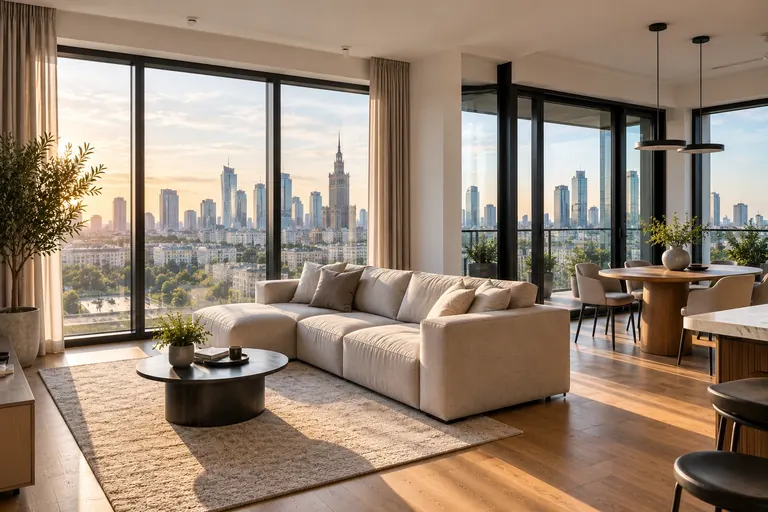
How much does it cost to rent an apartment in Warsaw in 2026?
Warsaw is Poland's most expensive rental market, but rents have been flat in 2026. Otodom Analytics data for May 2026 show small apartments up about 1% year on year and 60–89 m² units up 3.9%. In January 2026 the average asking rent in Warsaw was about 79 zł per m² per month (Rankomat and Rentier.io).
These are asking prices. What you actually pay depends on condition, floor, parking, lease length and whether utilities are included. Compare apartments by the full monthly total, not the headline number in the listing.
Average rent by apartment size
| Size | Average monthly rent | Change y/y |
|---|---|---|
| up to 40 m² | 2,957 zł | +1.3% |
| 40–59 m² | 3,897 zł | +0.9% |
| 60–89 m² | 6,095 zł | +3.9% |
Average asking rents on Otodom, Warsaw, May 2026. Usually excluding the building service charge (czynsz administracyjny) and utilities.
Otodom Analytics in a Bankier.pl report, May 2026 data (published 22 June 2026)
Rents by number of rooms and district
A snapshot of listings on 26 October 2026: about 49,000 offers from Otodom, Morizon, OLX and other portals. City median 3,200 zł a month, average 84 zł per m².
| Type or district | Average | Median |
|---|---|---|
| Studio (kawalerka) | 2,632 zł | 2,600 zł |
| 1-bedroom (2 rooms) | 3,505 zł | 3,300 zł |
| 2-bedroom (3 rooms) | 4,516 zł | — |
| 3-bedroom (4 rooms) | 5,467 zł | — |
| Wilanów | 5,277 zł | — |
| Wola | 4,216 zł | — |
| Mokotów | 4,128 zł | — |
| Ochota | 3,468 zł | — |
| Praga-Południe | 3,382 zł | — |
Asking prices, not signed deals; the sample does not cover the whole market. Polish listings count the living room as a room, so "2 rooms" is a one-bedroom. District averages cover all sizes, so districts with larger apartments come out higher.
What you pay on top of the rent
Polish listings often show the rent separately from other charges. Ask about each one before the viewing.
| Cost | What it is | When |
|---|---|---|
| Czynsz administracyjny | Building service charge to the owners' association or housing cooperative: maintenance, repair fund, waste, often advances for water and heating | Monthly, via the owner or directly |
| Utilities (media) | Electricity, gas, sometimes water and heating by meter | Per supplier bills or settled with the owner |
| Internet | Contract with a provider; sometimes already in place | Monthly |
| Deposit (kaucja) | Usually 1–2 months' rent; returned after move-out minus damage and arrears | Once, at signing |
| Parking | A garage space in new buildings is often rented separately | Monthly |
| Notary | Only for najem okazjonalny and instytucjonalny: the tenant's notarial statement | Once, before move-in |
The law caps the deposit at 12 months' rent for a standard lease and 6 months' rent for najem okazjonalny and instytucjonalny.
Which lease types exist in Poland?
Polish law has three types of residential lease. The type decides the deposit, the paperwork and how move-out works. This is general information, not legal advice.
Standard lease (umowa najmu)
Civil Code (Kodeks cywilny) art. 659 onwards, plus the tenants' rights act.
- No notary, no alternative address
- Fixed or open-ended term
- Simplest for the tenant
- Many owners avoid it and offer najem okazjonalny
- Deposit may legally reach 12 months' rent
Najem okazjonalny (occasional lease)
Art. 19a–19e of the tenants' rights act. A private owner lets the apartment for up to 10 years.
- The most common choice of private owners
- Deposit capped at 6 months' rent
- Clear rules for both sides
- Tenant signs a notarial statement agreeing to move out when the lease ends
- Tenant names another address to move to, with that owner's consent
- Extra notary cost
Najem instytucjonalny (institutional lease)
Art. 19f–19j of the same act. The landlord is a company whose business is renting.
- No alternative address needed
- Professional landlord, often whole build-to-rent buildings
- Deposit capped at 6 months' rent
- Notarial statement still required
- Rent increases only as the contract allows
- Less room to negotiate
A Polish lease, explained in your language
Leases are signed in Polish. We go through it with you in your language, clause by clause: term and early termination, rent indexation, what the czynsz covers, how the deposit is returned, pets and who pays for small repairs. Questions and changes are agreed with the owner before you sign.
For najem okazjonalny we tell you in advance which notarial statement to prepare and whose address to give. Our renting guide covers the details.
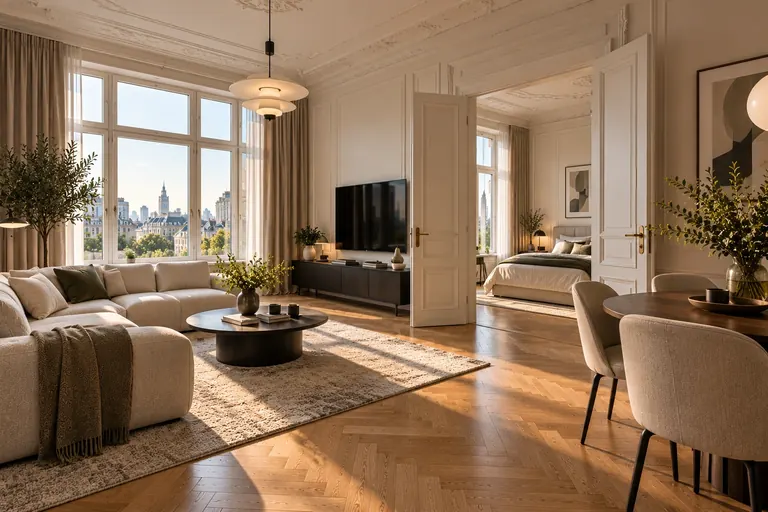
New build, pre-war townhouse or 1970s block?
The type of building affects price, bills and everyday comfort as much as the district does.
New build (apartamentowiec)
- Lift, underground parking, often security or a concierge
- Good insulation and lower heating bills
- Modern layouts, sometimes air conditioning
- Highest rent per m²
- Usually an open kitchen (aneks kuchenny) rather than a separate one
- Construction may still be going on nearby
Pre-war townhouse (kamienica)
- High ceilings and large rooms
- Central streets and period character
- Close to metro and trams
- Often no lift
- Gas heating and higher winter bills
- Hard to park, more street noise
1960s–80s block (blok)
- Cheaper than a new build
- Green courtyards and shops and schools nearby
- Usually good transport links
- Weaker sound insulation
- Older lifts and stairwells
- Interior standard varies a lot
When to search and what comes with the apartment
Demand in Warsaw rises at the end of summer, ahead of the academic year: in August and September there is less choice and you have to decide faster. Winter and spring are usually calmer. Start looking 3–4 weeks before your move-in date; earlier, owners rarely wait, later, choice narrows.
Most apartments are let furnished, with a hob, fridge, washing machine, bed and wardrobes. Kitchenware and linen are up to the owner. If you need an unfurnished apartment or are shipping your own furniture, tell us at the start: there are fewer of them.
A company can be the tenant for an employee. The lease then states who lives there, who pays the utilities and who signs the handover report. For several people we search in parallel and match move-in dates to start dates.
Where to live in Warsaw
Most people choose by commute, metro access and budget. Here is how the districts differ for daily life.
Śródmieście
City centre: both metro lines, Warszawa Centralna station, restaurants and offices on the doorstep. Pre-war townhouses and modern towers. Easy without a car, but louder and pricier per m².
Mokotów
Leafy Stary Mokotów with villas and parks, plus newer developments near the Służewiec office area. Metro M1. Popular with families and people working at Służewiec.
Wola
The business district around Rondo Daszyńskiego: office towers, metro M2 and many new gated developments with underground parking. Ideal if your office is nearby.
Żoliborz
Green and quiet, north of the centre: pre-war villas, parks, metro M1. Fewer listings, and good ones go fast.
Praga
The right bank of the Vistula. Praga-Północ has townhouses and lofts, Praga-Południe residential estates and Skaryszewski Park. Metro M2, often cheaper than the left bank.
Ochota
Next to the centre, with good trams and suburban rail, 1950s–70s blocks and new projects. A sensible balance of price and commute.
Wilanów
A newer district by the palace: spacious apartments, schools and nurseries, lots of green. No metro. The highest average rents in the snapshot above.
Ursynów
A residential district in the south with metro M1, Kabacki Forest and good facilities for children. About half an hour to the centre by metro.
Bielany
The north, with the M1 terminus at Młociny, Bielański Forest and a university campus. Calm and cheaper than the centre.
Suburbs within 30 km
Piaseczno, Pruszków, Łomianki, Marki, Ząbki, Konstancin-Jeziorna, Józefów: houses and garden apartments, more space for the money, but you commute by train or car.
What to check at a viewing
The list we take to viewings.
- The full monthly total: rent, czynsz administracyjny, estimated utilities, parking
- Who owns the apartment and whether they can let it (land register entry, księga wieczysta, or a contract)
- Heating: district or gas, individual meters
- Windows, damp and mould in corners, the bathroom and behind furniture
- Water pressure and hot water; hob, oven, washing machine, fridge
- Sockets, lighting, entry phone, which internet providers serve the building
- Noise: trams, building sites, nightlife; which way the windows face
- Pets, smoking, whether you can register your address (zameldowanie)
- Lease term, early termination, rent indexation
- Storage room, parking, bike room
The handover report (protokół zdawczo-odbiorczy)
On move-in day you and the owner sign a protokół zdawczo-odbiorczy, the handover report. It lists furniture and appliances and their condition, all meter readings and the number of keys, with dated photos of every room attached.
This document protects your deposit. At move-out the apartment is compared with the report, and the owner can keep money only for damage beyond normal wear. We help you draw it up and make sure it records everything you saw at the viewing.
How we find your apartment
Your request
Leave a request in the form at the bottom of the page, or message us on WhatsApp: district, budget, rooms, move-in date, children or pets.
Needs call
We clarify what matters: commute, schools, parking, building type, lease length.
Shortlist
We send apartments that fit, and check each one is still available before we send it.
Viewings
In person or by video call if you are not in Warsaw yet.
Negotiation and lease
We agree terms with the owner, explain the lease in your language and help with documents and the notary.
Handover
We prepare the handover report with photos and meter readings.
Questions and answers
How much is rent for an apartment in Warsaw?
According to Otodom Analytics for May 2026, an apartment up to 40 m² costs 2,957 zł a month on average, 40–59 m² costs 3,897 zł and 60–89 m² costs 6,095 zł. The building service charge and utilities usually come on top. Average rents are highest in Wilanów, Wola and Mokotów.
How big is the deposit?
Usually one or two months' rent. By law it cannot exceed 12 months' rent for a standard lease, or 6 months' rent for najem okazjonalny and najem instytucjonalny. It is returned after move-out, minus any damage and unpaid bills.
What is czynsz administracyjny?
A monthly charge paid to the building's owners' association or housing cooperative: upkeep and cleaning, the repair fund, waste collection and often advances for water and heating. Listings often show it separately from the rent, so always ask for the total.
What is najem okazjonalny?
A lease in which a private owner lets an apartment for a fixed term of up to 10 years. The tenant signs a notarial statement agreeing to move out when it ends and names another address to move to, with that owner's consent. It is set out in art. 19a of the tenants' rights act. This is general information, not legal advice.
How long are leases in Warsaw?
Usually 12 months with an option to extend. Six-month leases exist, but fewer owners accept them. Agree the early termination terms before signing, especially if your assignment could end early.
Can I rent with a pet?
Yes, though not every owner agrees. Mention your pet in your request: we will only show apartments where pets are allowed and ask for it to be written into the lease.
Can I view an apartment before I arrive in Warsaw?
Yes. We can arrange a video viewing and answer your questions on the spot. Do not transfer any money to an owner before a viewing and a signed lease.
Sources
Shortlist
Get a shortlist that fits your brief
Send a request: what you need, district, budget and dates. We check the properties are available and send you the ones that fit.