Warsaw and 30 km around
Renting office space in Warsaw: costs, districts and lease terms
Renting office space in Warsaw usually means a 3–5 year lease in an office building, or a flexible serviced office from one month. At the end of Q3 2026, central rents were typically 79–141 zł per m² per month before VAT, and 53–88 zł outside the centre (Knight Frank). We find an office that fits your team and budget, and we work in your language throughout.

How office leasing works in Warsaw
Warsaw has about 6.23 million m² of modern office space (PINK, Q3 2026). Most of it sits in office buildings in Śródmieście, around Rondo Daszyńskiego in Wola and in Służewiec in the south. The rest is offices in tenement houses (kamienice) and villas, lofts in Praga, and business parks on the city's edge.
Landlords of office buildings lease space on multi-year contracts and quote a headline rent per m² per month, net of VAT. That is not your invoice. Service charges, the add-on factor for common areas, VAT and parking all come on top, so we compare options by the full monthly cost rather than the headline rent.
In the centre, landlords currently have the upper hand. Only 4.3% of central office space was vacant at the end of Q3 2026, against 11.1% outside the centre, and no new office building was completed in Warsaw that quarter (PINK). If you need a few hundred m², start looking 6–9 months before your move.
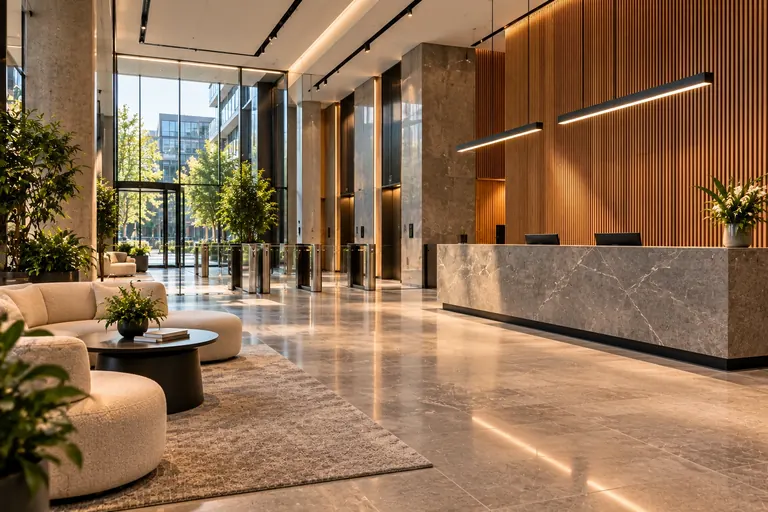
How much does office space cost in Warsaw in 2026?
Market ranges from the major advisory firms. Rent per m² per month, before VAT and service charges.
| Indicator | Value | Period |
|---|---|---|
| Rents in central locations | 79–141 zł/m² | end of Q3 2026 |
| Rents outside the centre | 53–88 zł/m² | end of Q3 2026 |
| Prime headline rent, city centre | ≈132 zł/m² | Q2 2026 |
| Prime rent outside the centre | up to ≈86 zł/m² | Q2 2026 |
| Service charges | 18–38 zł/m² | H1 2026 |
| Vacancy, all of Warsaw | 7.9% | end of Q3 2026 |
| Vacancy, central / non-central | 4.3% / 11.1% | end of Q3 2026 |
Rates converted to złoty at the NBP average rate of 26 Oct 2026 (table 208/A/NBP/2026), rounded to the nearest złoty. Service charges are given in złoty by the source.
Knight Frank, Q3 2026 (Eurobuild CEE, 20 Oct 2026) · BNP Paribas Real Estate Poland, Q2 2026 · Knight Frank, H1 2026 · PINK, Q3 2026 (Eurobuild CEE, 14 Oct 2026)
What makes up the price of an office
What a monthly bill for an office in a modern building usually includes:
Base rent
Price per m² per month, net of VAT. Check the lease for the rent currency and the exchange rate used to convert it to złoty when you pay.
Service charge
Security, cleaning of common areas, maintenance, property tax and building insurance. Knight Frank puts it most often at 18–38 zł per m² per month (H1 2026). It is billed in advance and reconciled once a year.
Add-on factor
Your share of lobbies, lift halls and washrooms, added to your floor area. With a 5% add-on factor, a 100 m² office is billed as 105 m².
VAT at 23%
Charged on both rent and service charge. A VAT-registered company normally recovers it; for a VAT-exempt business it is a real cost.
Parking
Underground spaces are leased separately, usually at a set ratio per 100 m² of office. They are scarce in the centre, so raise this early.
Electricity and internet
Electricity inside your office is usually metered; internet is contracted with a provider of your choice.
Worked example: the monthly cost of a 100 m² office
Based on a real listing in Służewiec, to show how a headline rent turns into an invoice.
| Item | Calculation | Per month |
|---|---|---|
| Rent | 63.84 zł × 105.17 m² | 6,713.81 zł |
| Service charge | 33.20 zł × 105.17 m² | 3,491.64 zł |
| VAT 23% | on rent and service charge | 2,347.26 zł |
| Total | excluding parking and electricity | 12,552.71 zł |
Add-on factor 5.17%: 105.17 m² billed instead of 100. Rent converted to złoty at the NBP rate of 4.4026 on 26 Oct 2026. This is a worked example, not our offer.
Office classes
What classes A, B and C mean
The class describes the standard of the building. It drives the rent, the service charge, the lease terms and how soon you can move in. Each district below shows the office classes you find there most often.
Class A
Modern or fully refurbished office buildings: air conditioning, raised floors, a building management system, reception, underground parking, often BREEAM or LEED certification.
Pros
- Prestige for clients and staff
- Predictable management and security
- Energy efficiency and practical layouts
Cons
- Highest rents and service charges
- Leases usually 3–5 years
- Space to be fitted out is not ready at once
Class B
Older or less central buildings with a good but no longer new standard. Often former class A offices that have aged.
Pros
- Lower rent than class A
- More flexible terms and lease length
- Often quicker to move in
Cons
- Older building systems and finishes
- Fewer services in the building
- Higher energy costs, less parking
Class C
Offices in tenement buildings, former industrial buildings and residential blocks, without the full systems of an office building.
Pros
- Lowest price
- Small units and short leases
- Characterful interiors: lofts, high ceilings
Cons
- Often no air conditioning, sometimes no lift
- Little parking
- Less representative and less accessible
Warsaw office districts at a glance
The main office locations in brief. In brackets: the office classes you will most often find there.
Śródmieście (A · B · C)
The city centre by the Palace of Culture and Warszawa Centralna station, on both metro lines. Highest rents and little free space, with tenement houses offering small Class C offices nearby.
Wola (A · B)
New towers around Rondo Daszyńskiego on metro line M2. Free space is almost gone, at about 2% vacancy (Knight Frank, end of Q3 2026), so start early.
Mokotów · Służewiec (A · B)
Służewiec is the largest office district outside the centre, with more choice and lower rents. Stary Mokotów and the Puławska corridor offer smaller offices closer to metro line M1.
Suburbs within 30 km (A · B)
Business parks and offices attached to warehouses along the main roads: Janki, Raszyn, Piaseczno, Pruszków, Marki. Easier parking and lower rents, longer trips by public transport.
How to choose a district and a building
Start with where your staff live and how clients will reach you. An office near the metro in Śródmieście or Wola suits a team that does not drive. Służewiec and the suburbs win on parking and price, but check public transport at rush hour.
Look at the building too: a BREEAM or LEED certificate matters if you report on ESG, and staff will notice bike parking, showers, weekend access and the quality of the air conditioning. If clients visit, the address and lobby carry more weight; for an internal team, cost per workstation does. We note all of this for each option on the shortlist.
Small office, serviced office or coworking?
For a team of up to 10–15 people, a conventional lease is not the only route. Small offices of 15–150 m² are found in Class B and C buildings, in tenement houses in Śródmieście, and in office buildings where the landlord splits a floor into modules. Leases for these units are often shorter and simpler.
A serviced office is a ready private office in an operator's centre: furniture, internet, reception, cleaning and meeting rooms come in one price per desk, on contracts from one month. Coworking is a hot desk or a fixed desk in a shared space. Both work well while you set up a Polish entity, grow the team, or look for a permanent office.
Conventional lease, serviced office or coworking
Conventional lease
From 100–200 m², multi-year contract
- Lowest cost per m² on a 3–5 year lease
- Fit-out to your layout and brand
- Rent-free months and a fit-out budget from the landlord
- Long commitment and a deposit of about three months
- Fit-out and furniture take months
- Service charge, internet and cleaning on top
Serviced office
A ready office from an operator
- Move in within days
- Contracts from one month, easy to scale up
- One price: furniture, internet, reception, cleaning
- More per desk over a long period
- Limited changes to the layout
- Shared common areas with other companies
Coworking
A desk in a shared space
- Smallest budget and commitment
- Fits 1–3 people
- Business address and meeting rooms when needed
- Little privacy
- Noise and no space of your own
- Not always right for client meetings
Office lease terms in Poland
This is general information, not legal advice. Leases are governed by the Polish Civil Code (art. 659 onwards), and each landlord sets the details in its own contract, which is in Polish.
Term
Usually 3–5 years in Class A buildings, longer for large floors or heavy landlord investment. Class B and C buildings and small offices often offer 1–3 years.
Fit-out
The landlord fits the office out to your layout. Knight Frank reports a typical landlord fit-out budget in new buildings of about 1,100–3,300 zł per m² (H1 2026, in złoty at the NBP rate of 4.4026 on 26 Oct 2026). Anything above it is paid by the tenant.
Rent-free period
In new buildings, 1.5–2 rent-free months for each year of the lease is standard (Knight Frank, H1 2026). The service charge is usually still payable.
Indexation
Rent is usually indexed once a year to the inflation index named in the lease (for example, GUS). Negotiate a cap where you can.
Deposit or bank guarantee
Typically about three months of gross payments. Many landlords accept a bank or insurance guarantee instead of a cash deposit.
Early exit and subletting
A fixed-term lease cannot simply be terminated. If your headcount may change, agree a break option, subletting rights and expansion options before signing.
Opening a Polish branch: what landlords will ask for
International companies often start in Warsaw in a serviced office and look for permanent space once the Polish entity and the team are in place. A landlord of a modern building will usually ask for a KRS extract, information about the parent company and security: a deposit, a bank guarantee or a parent company guarantee.
If the Polish entity is still being registered, space is sometimes reserved with a letter of intent and the lease signed later. You will need the office address for company registration and the tax office, so make sure the lease lets you use it as your registered address. This is general information, not legal advice.
After you sign: what else to plan for
At move-in, both sides sign a handover protocol recording the condition of the premises and the meter readings; you will need it when you leave. Leases usually require the tenant to hold third-party liability (OC) insurance and contents insurance.
Once a year the landlord reconciles the service charge, which can mean a top-up or a refund. On exit, leases often require you to reinstate the premises to their original state, for example by removing partitions. Agree the cost of reinstatement before signing, not at the end of the term.
What to prepare before the search
The clearer the brief, the shorter the shortlist. A request answering these is enough:
- Headcount now and in 2–3 years
- Private offices, meeting rooms, kitchen, server room needed?
- Preferred district or metro stations for your staff
- Monthly budget: net or gross, with or without service charge
- Move-in date and preferred lease length
- Number of parking spaces
- Company details for the landlord: KRS extract or registration documents of the parent company
How we find your office
We work in your language from first call to keys. The lease is in Polish, and we explain every clause to you before you sign.
Request
Leave a request in the form at the bottom of the page, or message us on WhatsApp: headcount, district, budget, timing.
Needs call
We ask how your team works, which rooms you need and what matters to staff and clients.
Shortlist
We select matching offices, check they are still available, and send them with the full monthly cost worked out.
Viewings
We plan viewings so you see several offices in one trip.
Negotiation and lease
We discuss rent, rent-free months, fit-out, indexation and exit terms with the landlord and walk you through the lease clause by clause.
Handover
We help with the handover protocol and checking the condition of the premises on move-in.
Offices by district and format
- Śródmieście (A · B · C)Offices in the city centre: towers, tenement houses, metro M1 and M2.
- Wola (A · B)Towers around Rondo Daszyńskiego on metro M2.
- Mokotów · Służewiec (A · B)The largest office district outside the centre, plus Stary Mokotów.
- Suburbs within 30 km (A · B)Business parks and offices at warehouses.
- Small officesOffices of 15–150 m².
- Serviced offices and coworkingReady offices and desks from one month.
- What an office really costsHow to work out the full monthly cost.
- Office lease in PolandWhat to check before you sign.
- Serviced office vs leaseWhen each one makes sense.
Questions and answers
How much does office space cost in Warsaw in 2026?
At the end of Q3 2026, central rents were typically 79–141 zł per m² per month and 53–88 zł outside the centre (Knight Frank, in złoty at the NBP rate on 26 Oct 2026). On top come service charges, most often 18–38 zł per m², the add-on factor and 23% VAT.
What is the service charge on a Warsaw office?
It covers running the building: security, cleaning of common areas, maintenance, property tax and insurance. You pay it monthly in advance per m² together with the rent, and the landlord reconciles it against actual costs once a year.
How long is a typical office lease in Warsaw?
Usually 3–5 years in Class A buildings. Class B and C buildings and small offices often offer 1–3 years. Serviced offices and coworking are available from one month. The longer the lease, the more rent-free time and fit-out budget a landlord will offer.
What deposit do landlords ask for?
Usually about three months of gross payments, including the service charge. Many landlords accept a bank or insurance guarantee instead of cash. We agree the amount and form of security before you sign.
Can a foreign company rent an office before its Polish entity is registered?
Yes, though an office-building landlord will want company documents and most likely a deposit or guarantee, sometimes from the parent company. Many international companies start in a serviced office, which needs less paperwork and gives the team a place to work while the permanent office is found.
How quickly can we move in?
Into a serviced office or coworking space within days. An office in a modern building fitted out to your layout usually takes several months, so start looking 6–9 months ahead for larger space. Ready-to-use units can be available sooner.
Do you search outside Warsaw?
Yes, within about 30 km: business parks and offices at warehouses in Janki, Raszyn, Piaseczno, Pruszków, Marki and other towns.
Sources
- Knight Frank, Warsaw office market, Q3 2026 (Eurobuild CEE, 20 Oct 2026)
- PINK, Warsaw office vacancy, Q3 2026 (Eurobuild CEE, 14 Oct 2026)
- Knight Frank, The Strength of Cities: Warsaw, H1 2026
- BNP Paribas Real Estate Poland, Office Market in Warsaw, Q2 2026
- Domiporta listing, July 2026 (worked example)
- Polish Civil Code (Kodeks cywilny), art. 659 ff. (lease), isap.sejm.gov.pl
- Polish VAT Act (ustawa o podatku od towarów i usług), isap.sejm.gov.pl
Shortlist
Get a shortlist that fits your brief
Send a request: what you need, district, budget and dates. We check the properties are available and send you the ones that fit.