District guide
Warsaw districts: where to live and where to rent an office
Most companies rent offices in Śródmieście, Wola or Służewiec (Mokotów), while expats tend to live in Mokotów, Żoliborz, Ochota, Ursynów, Wilanów or the new Praga. Two things decide it: access to metro line M1 or M2, and budget. In Q3 2026 only 4.3% of modern office space in the centre was vacant, against 11.1% outside it (PINK).
Updated:
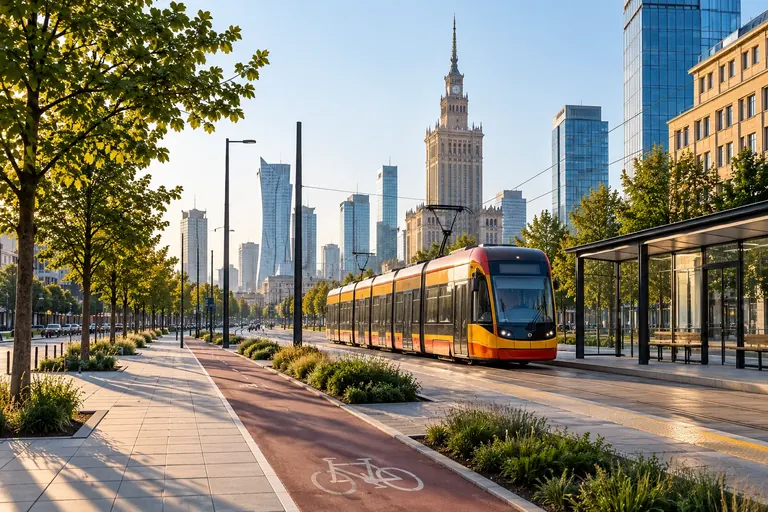
How Warsaw is laid out
Warsaw has 18 districts (dzielnice). The left bank of the Vistula holds the centre, the business areas and most of the older residential districts. The right bank (Praga, Targówek, Białołęka, Wawer) is cheaper and is where much of the new housing is going up.
The city runs on two metro lines. M1 goes north–south: Bielany, Żoliborz, Śródmieście, Mokotów, Ursynów. M2 goes west–east: Bemowo, Wola, Śródmieście, Praga, Targówek. Trams, buses and the SKM and Koleje Mazowieckie trains cover the rest. Living ten minutes from a metro station is often more convenient than living in the centre itself.
Office classes
What classes A, B and C mean
The class describes the standard of the building. It drives the rent, the service charge, the lease terms and how soon you can move in. Each district below shows the office classes you find there most often.
Class A
Modern or fully refurbished office buildings: air conditioning, raised floors, a building management system, reception, underground parking, often BREEAM or LEED certification.
Pros
- Prestige for clients and staff
- Predictable management and security
- Energy efficiency and practical layouts
Cons
- Highest rents and service charges
- Leases usually 3–5 years
- Space to be fitted out is not ready at once
Class B
Older or less central buildings with a good but no longer new standard. Often former class A offices that have aged.
Pros
- Lower rent than class A
- More flexible terms and lease length
- Often quicker to move in
Cons
- Older building systems and finishes
- Fewer services in the building
- Higher energy costs, less parking
Class C
Offices in tenement buildings, former industrial buildings and residential blocks, without the full systems of an office building.
Pros
- Lowest price
- Small units and short leases
- Characterful interiors: lofts, high ceilings
Cons
- Often no air conditioning, sometimes no lift
- Little parking
- Less representative and less accessible
Warsaw districts compared
| District | Character | Metro | Best for |
|---|---|---|---|
| Śródmieście (A · B · C) | City centre: office towers, tenement houses, Warszawa Centralna | M1 and M2 | Client-facing offices; car-free living |
| Wola (A · B) | Towers around Rondo Daszyńskiego, new apartment complexes | M2 | Tech and large companies; young professionals |
| Mokotów · Służewiec (A · B) | Służewiec: office district; Stary Mokotów: leafy streets | M1 (Mokotów); Służewiec by tram and SKM | Offices with parking; families |
| Żoliborz (B · C) | Pre-war houses, villas, parks | M1 | Families; small studios and practices |
| Praga (B · C) | Lofts in former factories, new buildings | M2 | Creative teams; lower rents near the centre |
| Ochota | Quiet residential area, universities | None; trams, SKM, WKD | Students, couples, people working downtown |
| Wilanów | New neighbourhoods, palace and parks | None; trams and buses | Families with children |
| Ursynów | Large green residential district, Las Kabacki | M1 | Families commuting by metro |
| Bielany | Green north, Las Bielański, campuses | M1 | Families, park lovers |
| Białołęka | Lots of new housing, right bank | None; trams, buses, trains | More space for less money |
| Suburbs within 30 km (A · B) | Office parks, warehouses with offices, houses | Trains or buses | Logistics, production, families with a car |
Best districts for an office in Warsaw
Where to look for office space in Warsaw when staff, clients and budget all matter.
Śródmieście (A · B · C)
New towers around Warszawa Centralna, Rondo ONZ and Plac Grzybowski; Class B and C offices on Marszałkowska and in tenement houses. M1 and M2 cross here, so the whole city can reach you. High rents and little free space.
Wola (A · B)
The business district around Rondo Daszyńskiego on metro M2. Knight Frank put vacancy there at just 2% of modern stock at the end of June 2026. A fit for companies that are hiring and want a new building.
Mokotów · Służewiec (A · B)
Służewiec is a large office area outside the centre: many buildings, parking and quick access to the ring roads. Vacancy is higher than in the centre (17% in Q2 2026, BNP Paribas), so you get more choice and more room to negotiate.
Żoliborz (B · C)
Small offices in villas and residential buildings near M1. Suits studios, practices and teams of up to 10–15 people.
Praga (B · C)
Lofts in former factories, offices in restored buildings and new projects near M2. For creative and tech teams who care about character.
Suburbs within 30 km (A · B)
Office parks and warehouse complexes with offices in Janki, Raszyn, Piaseczno, Pruszków and Marki. For companies that need storage, parking and motorway access.
Warsaw office market by zone, 2026
| Zone | Vacancy | Rents, zł/m²/month |
|---|---|---|
| City centre | 4.3% (Q3 2026) | up to ≈132 zł (prime, Q2 2026) |
| Rondo Daszyńskiego (Wola) | 2.0% (June 2026) | — |
| Outside the centre | 11.1% (Q3 2026) | up to ≈86 zł (Q2 2026) |
| Służewiec | 17% (Q2 2026) | — |
| Ursynów and Wilanów | 2.7% (Q2 2026) | — |
Rents exclude VAT and are converted to złoty at the NBP average rate 4.4026 (table 208/A/NBP/2026, 26.10.2026). Service charges most often run 18–38 zł/m² a month (Knight Frank, H1 2026).
PINK via Eurobuild CEE, 14.10.2026 · BNP Paribas Real Estate, Q2 2026 (11.08.2026) · Knight Frank, Warsaw H1 2026
Best districts to live in Warsaw for expats
Short portraits for anyone looking for an apartment to rent.
Śródmieście
Everything on your doorstep, but noisy and expensive. Pre-war flats with high ceilings and new buildings in Powiśle. For people who live without a car.
Mokotów
One of the most popular districts: Stary Mokotów with villas and parks, metro M1, schools and nurseries. For families and anyone working downtown or in Służewiec.
Żoliborz
A quiet, green district north of the centre, with pre-war houses, new buildings and metro M1.
Wola
Plenty of new apartment complexes right next to the office towers and M2. For young professionals who want to walk to work.
Ochota
A calm district close to the centre, with campuses and Park Szczęśliwicki. No metro, but trams and trains get you downtown quickly.
Ursynów and Wilanów
Ursynów is green and quiet, with metro M1 and Las Kabacki. Wilanów has new neighbourhoods, parks and schools, but no metro, so many families drive.
Bielany and Białołęka
Bielany is the green north on M1, with forest and campuses. Białołęka has lots of new housing for less money, but a longer trip to the centre.
Praga
The right bank: lofts, restored tenement houses and new buildings on M2. Full of character and closer to the centre than it looks.
Suburbs within 30 km of Warsaw (A · B)
For offices: office parks and warehouses with offices. For living: houses and larger apartments.
Piaseczno
A town south of Warsaw with a direct train to the centre. Apartments, houses and business parks along the S7.
Pruszków
West, on the SKM and Koleje Mazowieckie lines. Plenty of housing and warehouses with offices near the motorway junctions.
Janki and Raszyn
South-west, by Chopin Airport and the S8 and S2: retail and office-warehouse parks. Good for logistics and service companies.
Łomianki
North, next to Kampinos National Park. Family houses; Warsaw by bus or car.
Marki and Ząbki
North-east: lots of new housing. Ząbki has a train line; Marki has buses and the S8.
Konstancin-Jeziorna and Józefów
Quiet, green towns to the south and south-east with villas and gardens. Józefów has a train; Konstancin relies on buses.
Choosing an office district: five questions
Where do your people live?
Check which metro and train lines they use. An office where M1 and M2 cross works for almost everyone.
How often do clients visit?
For meetings, a representative building and an easy trip from Warszawa Centralna and the airport matter.
Do you need parking?
Spaces are scarce and expensive in the centre, more plentiful in Służewiec and the suburbs.
What is the budget with VAT and service charge?
Work with the full monthly total, not just the rent per m².
Will the team grow?
A building with spare space lets you expand without another move.
City centre, green district or suburbs?
Centre (Śródmieście, Wola)
- Metro and everything nearby
- No car needed
- Highest rents
- Noise and tourists
Green districts (Mokotów, Żoliborz, Ursynów, Bielany)
- Parks, schools, quiet streets
- Metro M1 to the centre
- Good flats go fast
- Fewer new buildings in older areas
Suburbs within 30 km
- More space for the same money
- Houses with gardens
- Rush-hour commute
- Often need a car
What does it cost to live in Warsaw?
Average asking rents in Warsaw in May 2026 (Otodom Analytics): up to 40 m², 2,957 zł a month; 40–59 m², 3,897 zł; 60–89 m², 6,095 zł. Śródmieście, Wola and new buildings in Mokotów are usually above average; Białołęka and the suburbs below. Our guide to renting an apartment shows how to add up the full budget with czynsz and utilities.
Need help choosing a district?
Leave a request in the form at the bottom of the page, or message us on WhatsApp, with where you or your team will work, your budget and what matters: metro, schools, parking. We work in your language: we suggest districts, check that places are available and send a shortlist of offices or apartments.
Offices and apartments by district
- Offices in Śródmieście (A · B · C)City centre, both metro lines.
- Offices in Wola (A · B)Towers at Rondo Daszyńskiego, M2.
- Offices in Mokotów · Służewiec (A · B)Office district with parking.
- Offices around Warsaw (A · B)Office parks and warehouses with offices.
- Apartments for rent in WarsawFlats in every district and the suburbs.
- How to rent an apartmentBudget, lease, handover, registration.
Questions and answers
What is the best district to live in Warsaw for expats?
It depends on where you work and whether you have children. Families often choose Mokotów, Żoliborz, Ursynów or Wilanów for green space and schools. Wola and Śródmieście suit people without a car. Białołęka and the suburbs give more space for the money but longer commutes.
Where are the main office districts in Warsaw?
Śródmieście, Wola around Rondo Daszyńskiego, and Służewiec in Mokotów. Smaller offices are found in Żoliborz and Praga, and office parks in the suburbs. In Q3 2026, 4.3% of central office space was vacant against 11.1% outside the centre (PINK).
Which Warsaw districts are on the metro?
Line M1 serves Bielany, Żoliborz, Śródmieście, Mokotów and Ursynów. Line M2 serves Bemowo, Wola, Śródmieście, Praga and Targówek. Ochota, Wilanów and Białołęka have no metro; you get there by tram, bus or train.
Is Służewiec a good place for an office?
If parking, car access and choice matter, yes. Vacancy there is higher than in the centre (17% in Q2 2026 according to BNP Paribas), which gives room to negotiate. The downside is that Służewiec itself has no metro station.
Is Praga a good place to live?
Praga has changed a lot: restored tenement houses, lofts and new buildings near metro M2. As in any large district, streets vary. View the flat in the evening and walk the route to the metro.
Should I live in the suburbs of Warsaw?
If you want a house or more space and have a car, it can work well. Piaseczno, Łomianki, Ząbki, Józefów and other towns within 30 km are linked to Warsaw by train or bus. Check the rush-hour commute before signing.
Sources
Shortlist
Get a shortlist that fits your brief
Send a request: what you need, district, budget and dates. We check the properties are available and send you the ones that fit.